

FUE Hair Transplant for Women

Hair loss in women is more common than is often acknowledged, and its impact on confidence and daily life can be significant. Female hair loss patterns, causes, and the surgical planning required to address them differ substantially from those seen in men. A FUE hair transplant for women at Hair Transplant Centre Toronto is planned and executed specifically around the anatomy, physiology, and aesthetic requirements of each female patient, not adapted from a male protocol.
Dr. Kristy Bailey, a double-board-certified dermatologist and the #1-rated dermatologist among 233 practitioners in Toronto on RateMDs, has specific experience in diagnosing and treating female hair loss. Because many conditions that cause hair loss in women require a dermatological diagnosis before surgery is appropriate, Dr. Bailey’s background in dermatology is directly relevant to every aspect of planning a hair transplant for a female patient. Not all women experiencing hair loss are suitable candidates for transplantation, and identifying the right patients is as important as the surgical technique itself.

Personalized Care

Seamless Experience

Trusted Expertise
Hair loss in women is more common than is often acknowledged, and its impact on confidence and daily life can be significant. Female hair loss patterns, causes, and the surgical planning required to address them differ substantially from those seen in men. A FUE hair transplant for women at Hair Transplant Centre Toronto is planned and executed specifically around the anatomy, physiology, and aesthetic requirements of each female patient, not adapted from a male protocol.
Dr. Kristy Bailey, a double-board-certified dermatologist and the #1-rated dermatologist among 233 practitioners in Toronto on RateMDs, has specific experience in diagnosing and treating female hair loss. Because many conditions that cause hair loss in women require a dermatological diagnosis before surgery is appropriate, Dr. Bailey’s background in dermatology is directly relevant to every aspect of planning a hair transplant for a female patient. Not all women experiencing hair loss are suitable candidates for transplantation, and identifying the right patients is as important as the surgical technique itself.


FUE Hair Transplant Benefits for Women
FUT Strip Method: For patients who do not wish to shave their head, particularly female patients seeking a hair transplant without visibly altering their hairstyle, the FUT strip method allows for higher-volume graft harvesting while the surrounding hair conceals the donor site. Dr. Bailey personally performs the strip excision, a step many clinics cannot offer because it requires a physician rather than a technician.


Best Candidates for a Hair Transplant for Women in Toronto
Candidacy for FUE hair transplant in women requires careful assessment, as several common causes of female hair loss must be ruled out or stabilized before surgery is appropriate. Dr. Bailey conducts a thorough evaluation during your free consultation.



Hair Transplant Procedure
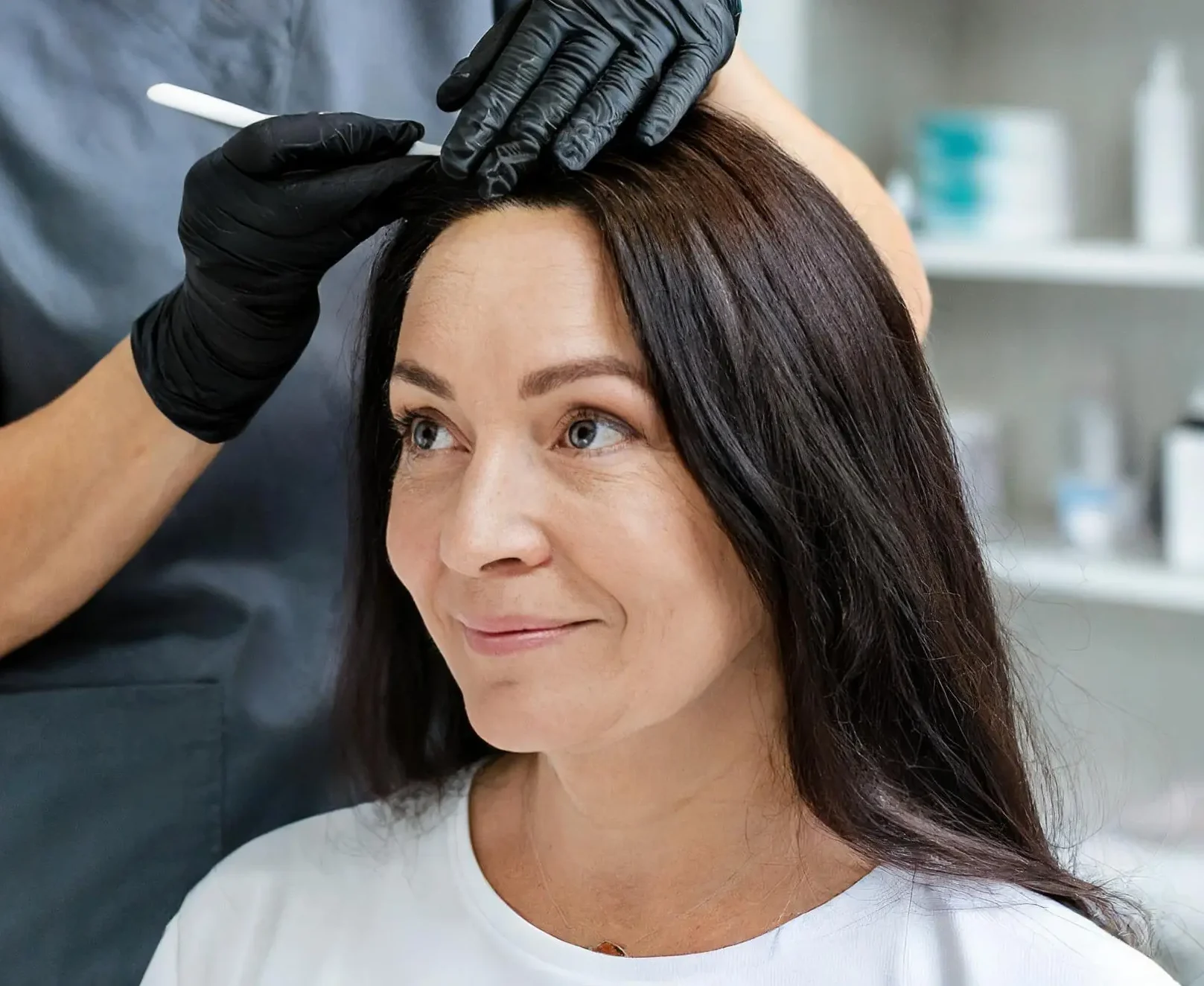
The FUE Hair Transplantation procedure involves a step-by-step process designed to ensure a seamless and effective experience. It all begins with an initial consultation, where you meet with our experienced Dermatologist and hair transplant specalist, Dr. Kristy Bailey, to discuss your specific goals and expectations.
The donor area and area of concern are carefully and artistically mapped out. During the procedure, local anesthesia is administered by Dr. Bailey to ensure your comfort. The next steps involve the extraction of individual follicular units from the donor site, typically located on the back or sides of your head. These healthy follicles are then meticulously implanted into the areas experiencing hair loss. The result is a natural-looking and lasting solution to hair restoration, tailored to your unique needs and preferences.
Hair Transplant Procedure
The FUE Hair Transplantation procedure involves a step-by-step process designed to ensure a seamless and effective experience. It all begins with an initial consultation, where you meet with our experienced Dermatologist and hair transplant specalist, Dr. Kristy Bailey, to discuss your specific goals and expectations.
The donor area and area of concern are carefully and artistically mapped out. During the procedure, local anesthesia is administered by Dr. Bailey to ensure your comfort. The next steps involve the extraction of individual follicular units from the donor site, typically located on the back or sides of your head. These healthy follicles are then meticulously implanted into the areas experiencing hair loss. The result is a natural-looking and lasting solution to hair restoration, tailored to your unique needs and preferences.
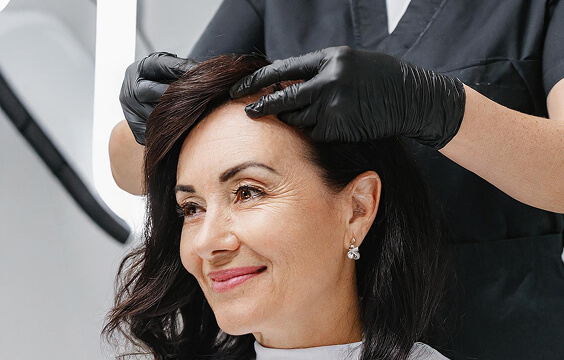
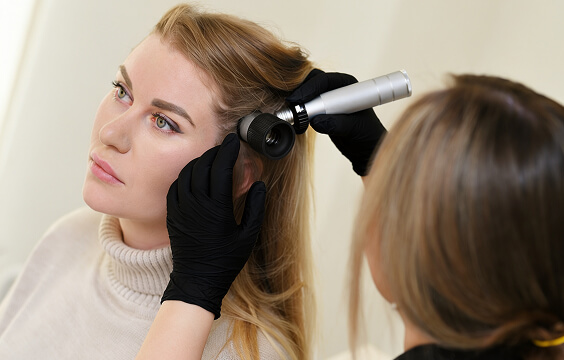
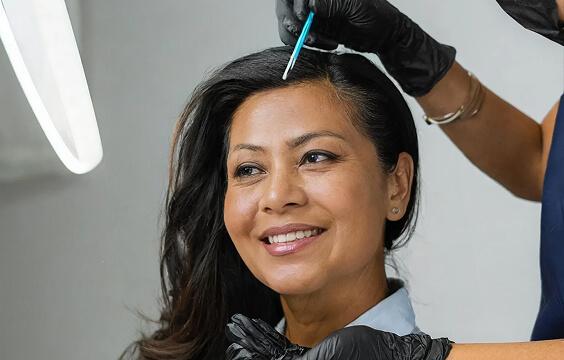
Your journey begins with a one-on-one consultation with Dr. Bailey at our downtown Toronto clinic. Dr. Bailey examines your scalp under magnification, assesses the cause and pattern of your hair loss, evaluates donor hair density and quality, and reviews your medical history, including any hormonal treatments, medications, or supplements you are taking.
Because the planning of a female hair transplant requires an understanding of the underlying diagnosis, the consultation may involve additional assessment steps before a surgical plan is recommended. If non-surgical treatments are more appropriate for your presentation, Dr. Bailey will discuss these during the consultation. If surgery is appropriate, you will leave with a written pre-operative checklist covering medications to pause, alcohol and smoking restrictions, and scalp care instructions to begin in the weeks before surgery.
On the day of the procedure, Dr. Bailey reviews the recipient zone design with you before any extraction begins. In female hair transplantation, the distribution of grafts is typically planned to improve overall density across a diffuse thinning area rather than to rebuild a defined hairline, though hairline work is also performed where appropriate. Both the donor and recipient areas are prepared, and a local anesthetic is administered to ensure the procedure is comfortable throughout.
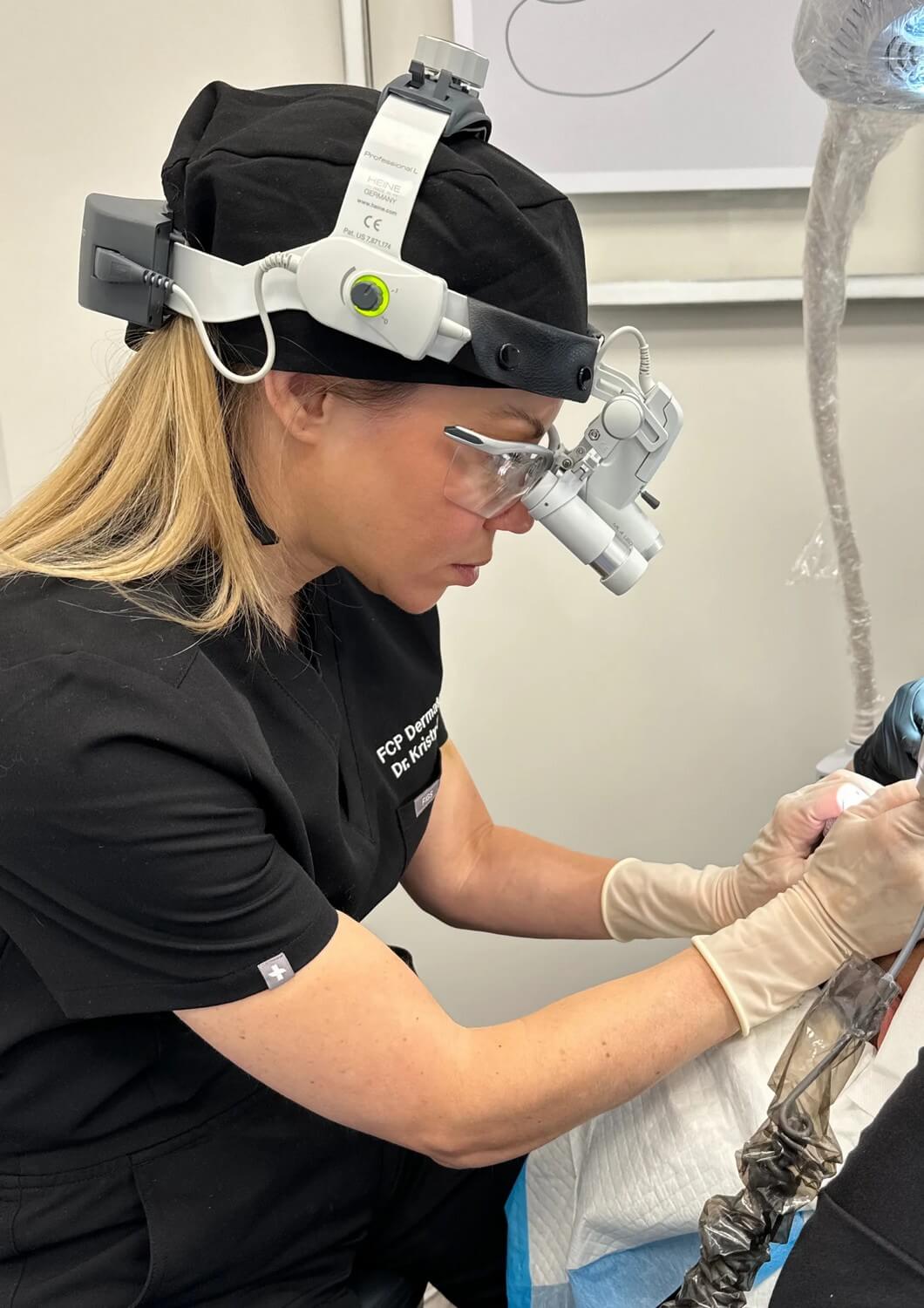
Dr. Bailey uses a precision micro-punch to extract follicular units from the donor area one at a time. Each graft is assessed for viability and stored in a preservation solution. Recipient sites are created at angles and depths matched to your existing hair growth direction, and each follicular unit is placed by hand by Dr. Bailey. Depending on graft count, the procedure typically takes five to eight hours, with scheduled breaks throughout.
You will leave the clinic the same day with written aftercare instructions and a prescribed care kit. Mild swelling and pinpoint redness at the graft sites are normal during the first week. Transplanted hairs shed between weeks two and four, which is a normal part of the follicle cycle and does not indicate graft failure.
New hair growth begins to emerge from approximately month three. Density builds progressively, with roughly half of the final result visible at six months and the complete outcome assessed at twelve months. Follow-up appointments are scheduled at one week, three months, six months, and twelve months to monitor your progress.
Technology, Results, and Recovery
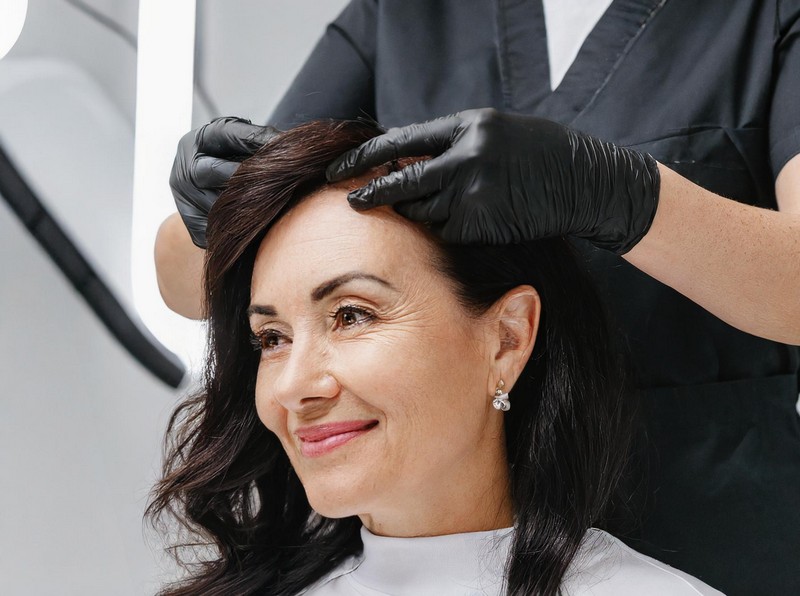
Hair Transplant Centre Toronto uses the latest generation of micro-punch instrumentation and graft preservation media. Dr. Bailey completed her FUE training alongside internationally recognized hair restoration specialists and continues to attend advanced surgical education programmes annually. Female hair transplantation requires particular attention to donor zone selection and graft distribution, as the diffuse thinning patterns common in women demand a different extraction and placement strategy than the more localized patterns typical in male patients.
New hair growth from transplanted follicles is permanent. The relocated follicles are sourced from stable donor zones and continue growing in their new location for life. Hair calibre and density normalize fully by months ten to twelve. For patients with ongoing native hair loss in the surrounding areas, Dr. Bailey may recommend complementary non-surgical treatments, including PRP therapy, Viviscal supplements, or the Theradome laser helmet to slow progression and preserve the overall result.
Most patients return to normal daily activities within two to three days following a FUE hair transplant. Mild swelling and pinpoint scabbing at the graft sites resolve within the first week. Transplanted hairs shed in weeks two to four, which is normal. New growth begins around month three and develops progressively through month twelve. Strenuous activity and direct sun exposure to the scalp should be avoided for 2 weeks following the procedure.

Hair Transplant Centre Toronto uses the latest generation of micro-punch instrumentation and graft preservation media. Dr. Bailey completed her FUE training alongside internationally recognized hair restoration specialists and continues to attend advanced surgical education programmes annually. Female hair transplantation requires particular attention to donor zone selection and graft distribution, as the diffuse thinning patterns common in women demand a different extraction and placement strategy than the more localized patterns typical in male patients.

New hair growth from transplanted follicles is permanent. The relocated follicles are sourced from stable donor zones and continue growing in their new location for life. Hair calibre and density normalize fully by months ten to twelve. For patients with ongoing native hair loss in the surrounding areas, Dr. Bailey may recommend complementary non-surgical treatments, including PRP therapy, Viviscal supplements, or the Theradome laser helmet to slow progression and preserve the overall result.

Most patients return to normal daily activities within two to three days following a FUE hair transplant. Mild swelling and pinpoint scabbing at the graft sites resolve within the first week. Transplanted hairs shed in weeks two to four, which is normal. New growth begins around month three and develops progressively through month twelve. Strenuous activity and direct sun exposure to the scalp should be avoided for 2 weeks following the procedure.
FUE Hair Transplant for Women: Dr. Kristy Bailey
Dr. Kristy Bailey is a double-board-certified dermatologist whose clinical practice focuses on hair, scalp, and nail disorders. Her dermatological training is particularly relevant to female hair transplantation, because the differential diagnosis of hair loss in women is considerably more complex than in men. Hormonal conditions, nutritional deficiencies, autoimmune disorders, and traction-related causes must all be assessed and addressed before surgery is appropriate, and identifying the right candidates for transplantation is a clinical skill that depends on this diagnostic expertise.
Rated number one among 233 dermatologists in Toronto on RateMDs, Dr. Bailey personally performs every hair transplant at our King Street West clinic in Toronto. Female patients choose Hair Transplant Centre Toronto specifically because Dr. Bailey’s dermatological foundation means that the decision to proceed with surgery is always grounded in a complete clinical assessment, not simply a willingness to operate.

Commonly Asked Questions
Yes. Female hair loss patterns, causes, and donor zone characteristics differ substantially from those seen in men, and the surgical planning must reflect these differences. Female pattern hair loss typically presents as diffuse thinning across the top of the scalp rather than a receding hairline, which requires a different approach to graft distribution. The donor zone assessment is also more complex, as thinning can sometimes affect the back and sides of the scalp in women as well as the top.
FUE transplantation is most appropriate for women with stable androgenetic alopecia, traction alopecia, hairline recession from frontal fibrosing alopecia in carefully selected cases, and scarring or trauma-related hair loss where follicles in the affected area are no longer viable. Hair loss from active hormonal conditions, nutritional deficiency, or telogen effluvium is typically addressed with medical management rather than surgery. Dr. Bailey establishes the diagnosis before making any surgical recommendations.
During your consultation, Dr. Bailey examines your scalp under magnification, assesses donor density and quality, reviews your medical history and any relevant blood work, and evaluates the cause and pattern of your hair loss. If active or reversible causes are identified, these are addressed first. Surgery is recommended only when the hair loss pattern is stable and the donor supply is sufficient to produce a meaningful result.
In many cases, a full shave of the recipient area is not required for female hair transplant patients, as the existing hair can conceal the graft sites during healing. The extent of any shaving required depends on the area being treated and the number of grafts planned, and is discussed in detail during the consultation.
Graft count depends on the size and density of the area being treated. Partial coverage of a thinning zone may require 1,000 to 2,000 grafts; more extensive diffuse thinning can require 2,000 to 3,500. Dr. Bailey provides a specific estimate during your consultation based on scalp measurements and donor assessment.
Local anesthetic is administered before any extraction or incision begins. The procedure itself is comfortable for the vast majority of patients. Mild postoperative soreness for 1 to 2 days is typical and manageable with over-the-counter pain medication.
Transplanted hairs shed between weeks two and four, which is normal. New growth begins emerging around month three; approximately half the result is visible by month six, and the full outcome is assessed at twelve months.
Yes. Both FUE and FUT can often be performed without a full shave, as surrounding hair conceals the treated area during healing. For women who want to avoid shaving altogether, particularly those seeking a higher graft count in one session, FUT is often the better option, since the strip is removed from a single donor line that is easily hidden by the hair above it. Dr. Bailey performs the strip excision personally, which is not the case at many clinics, where this step is delegated to a technician rather than a physician.
Yes. The transplanted follicles are sourced from stable donor zones and continue growing in their new location for life. However, native hair in the surrounding areas may continue to thin over time, and Dr. Bailey discusses a longer-term management plan for this during your consultation.
Yes. PRP therapy is frequently recommended alongside transplantation to support graft survival and stimulate surrounding follicles. Non-surgical treatments, including Viviscal supplements, the Theradome laser helmet, Hydrafacial Keravive, and Aquagold microneedling, may also be recommended to manage ongoing hair loss around the transplanted zone.
Once the transplanted hair has fully grown in and the scalp has healed, you can colour, cut, and style your hair as you would normally. Dr. Bailey provides specific guidance on when it is appropriate to resume chemical treatments based on your individual healing progress.